Why Is My Montana Lawn Yellow? A Diagnostic Guide

You watered it. You fed it. And in the third week of June, your Montana lawn went yellow anyway.
It is almost never a disease. What it usually is, and this is the part that costs people money, is a shortage. Iron locked up by lime. Oxygen squeezed out of heavy clay. Water that never reached the roots at all. Three different shortages, three completely different fixes, and no way to tell them apart from the driver's seat of a car.
Green is the color we read as alive, and yellow is the color we read as failure. The instinct is right, and it is also useless, because a yellow lawn in Montana is usually describing one of eight different causes and the treatment for the wrong one costs money every season you get it wrong. Eight causes is a lot to hold in your head at once, so do not try. Down this page you will meet all of them, roughly in the order you are most likely to meet them in a real yard.
So this page is not going to sell you anything. It is going to help you name the cause, and that matters more than it sounds, because if you work down the list you will cross most of it off before you spend a dollar.
What's causing my yellow lawn? A diagnostic table
Use it like this. Find the row that matches what you are actually looking at, and confirm it before you treat anything.
| What you're seeing | Likely cause | Confirm it by |
|---|---|---|
| Yellow patches on high, dry, alkaline ground; ornamentals yellow with green veins | Iron chlorosis | Soil pH test: above 8.3, iron locks up (MSU Extension) |
| Whole lawn fades to pale yellow-green, oldest growth first | Nitrogen deficiency | Soil test; look for a uniform fade, not patches |
| Yellow that fades to the tips, footprints stay visible, blades curl | Drought stress | Screwdriver test: dry several inches down |
| Yellow at the base, in the lowest and wettest ground; sour or algae-slick soil | Overwatering | Screwdriver test: saturated or mucky soil |
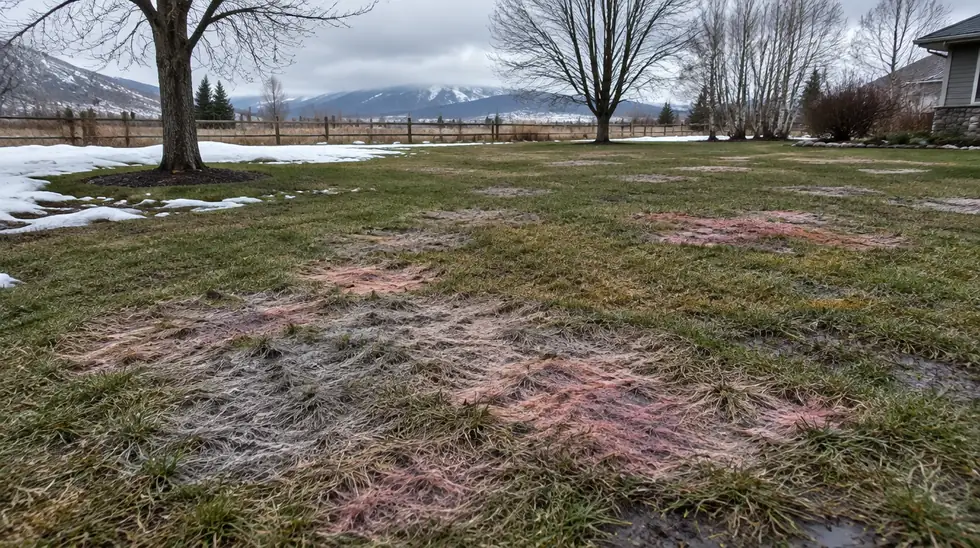
| Matte gray patches that appear as the snow melts | Gray snow mold (Typhula) | Timing: it shows up at snowmelt and dries out on its own |
| Circular patches with dark green rims | Dog spots | Location: concentrated where the dog goes |
| Yellow that lifts away from the soil like loose carpet | Grub damage | Tug a patch; dead roots give way |
| Yellow in the traffic lanes and worn paths | Compaction | Soil is hard to push a tool into |
Read that right-hand column again, because it is doing more work than the other two. Most of these you can confirm for free, with your eyes, your hands, or a screwdriver. Two you cannot, and those two are iron chlorosis and nitrogen deficiency, which need a soil test. Which of these can you rule out in ten seconds? Which one have you already been told you have?
It is the difference between reading a lawn and guessing at one.
Start here: three questions that cut the list in half
Before you consider a single cause, answer three questions.
- Is the yellowing uniform, or is it patchy? Uniform yellow over the whole stand points hard at nutrition. Patchy yellow points at water, soil, or biology.
- Did it begin the week the snow melted, or in a dry stretch in July? Yellow that arrives at snowmelt is a different problem from yellow that arrives in a drought.
- Does it follow a shape? A ring, a streak along a slope, a circle under a tree, a cluster where the dog goes. The shape is a clue, not decoration.
Three answers, and half the page is gone.
Iron chlorosis: the classic Montana cause
If you have to bet on one cause in this state, bet on this one.
Most Montana soils are high in calcium and run alkaline, and eastern Montana surface pH is typically 7 to 8. Above pH 8.3 you should expect deficiencies of phosphorus, potassium, iron, zinc, and manganese, because the higher the pH climbs the more of those nutrients the soil holds out of reach, and free lime makes iron chemically unavailable to the plant even when there is plenty of iron sitting in the ground. That is how you end up with a lawn going yellow over soil that looks perfectly fertile from the top. The ground looks fine. The ground is the problem.
You will see the textbook symptom most clearly on woody plants, where the leaves turn yellow but the veins stay green, and MSU Extension names apple, maple, and poplar as the ornamentals most prone to it. Linden, ash, boxelder, oak, elm, hawthorn, and honeylocust tolerate the very same alkaline ground without complaint.
In grass you will not get that green-vein pattern at all. The blades simply fade, most often on the ground where the pH runs highest.
Here is what to do about it. Chelated iron or ferrous sulfate will green the plant up. Both are temporary—and neither one touches the soil. The problem came back last year. It will come back next year.
And here is what the wrong approach costs. Fertilization runs $77 to $395 an application, and an annual lawn-care program runs $1,200 to $4,920. Five seasons of that program is $6,000 to $24,600. That is the same money as a full xeriscape conversion. Sod, if you give up and start over, averages $2,076—the national figure, before the Montana labor premium, which runs 10 to 20 percent above the national average and higher still in Bozeman.
That is the five-season price of guessing.
Then there is the temptation to change the soil itself, and one number should end it. To drop soil pH from 8.0 to 7.5, MSU Extension cites roughly 10,000 pounds of elemental sulfur per acre. Five tons, and you would need it on every acre you own. That is a farm-scale answer to a yard-scale problem, and for a home lot the math is not worth running.
The honest answer is the one MSU gives. Choose species adapted to the pH you actually have. Native and pH-adapted planting beats fighting the soil. See what native plants will actually take your ground.
One terminology note, because you will see it wrong everywhere. Montana soils are calcareous, high in free lime, or simply high pH. Those are the correct terms. Some national sites borrow a Southwest-US word for the condition that does not describe Montana soil at all.
A CALCAREOUS SOIL CARRIES ENOUGH FREE LIME TO PUSH pH UP AND HOLD SEVERAL NUTRIENTS, IRON AMONG THEM, OUT OF THE PLANT'S REACH.
INSIGHT The soil is not short of iron. The soil is locked. More iron greens the plant for a few weeks and changes nothing underneath it.
CAUTION Do not read "high pH" and reach for sulfur on a living lawn. At anything near the rate you would need, it is a path to burnt grass. Treat the appearance if you must. Change the planting, not the soil.
Nitrogen deficiency: uniform, and it starts low
Nitrogen deficiency looks different. It is uniform across the whole stand instead of patchy, and it hits the older growth first, so the lower tissue yellows before the newest blades do.
On a Montana lawn the reason is plain. Our soils are often thin, sandy, or nutrient-poor, especially on river-terrace and outwash ground. If you never feed the lawn, or you fed it once in April and stopped, nitrogen is the likeliest explanation for a whole-lawn fade by midsummer.
A soil test from MSU Extension will tell you what you are actually short of, so you are not guessing at what to buy.
Drought stress vs. overwatering: how to tell them apart
These two look alike and treating the wrong one makes it worse, so in Montana you have to look at the soil, not the calendar.
"But I water it," you say. Watering and watering correctly are two different things. Two of the most common Montana causes produce yellow on a lawn you water faithfully.
Drought stress shows as yellow that fades toward the tips, and the giveaway is footprinting. Walk across the lawn and your footprints stay visible while the blades fail to spring back. Sandy river-terrace and outwash soils get there first, because they drain fast and hold little water or nutrient, while the heavy glacial-lakebed clays that fill the Flathead and Missoula valleys go the other way entirely and hold too much. On ground like that it is easy to overwater and nearly impossible to underwater, and overwatering starves roots of oxygen on top of everything else. Shallow watering makes it worse in a different way, because it trains roots up to the surface where one dry week can finish them.
The test that settles it. Push a screwdriver into the soil a few inches down. If it goes in hard and the soil is dry below the surface you are underwatering. If the tool slides through muck you are overwatering—and that is the opposite problem, with the opposite fix. Check the same spot three days running before you change anything.
The calendar matters here too. In Bozeman, sprinkler watering is permanently capped at three days a week, with even addresses on Tuesday, Thursday, and Saturday and odd addresses on Wednesday, Friday, and Sunday. That is not a drought rule but a permanent one. Water deeply and infrequently, and let the soil dry between cycles.
Snow mold: the spring surprise
If your yellow arrives the week the snow melts, in matted gray patches that look like someone threw a wet blanket over the turf, you are probably looking at gray snow mold. It is genuinely common in Montana, and it clears on its own as the ground dries and warms.
The fix is almost entirely cultural, and it happens in the fall, months before you see any damage:
- Don't over-fertilize in the fall. A late push of soft growth goes into winter as a buffet for mold.
- Keep mowing until dormancy. Long, matted grass is the mold's habitat.
- Don't pile snow on the turf. Where you pile snow you get mold, and worse, you get the winter burn that browns evergreens and turf alike.
- Improve drainage so meltwater does not sit in the same spot every March.
MSU Extension is blunt about treatment: fungicides are "not usually recommended for home lawn use," so rake the matted patches to let air in and fix the conditions that caused them. A season of prevention in the fall will always beat a spray in the spring. It is the cheapest cure on this page.
The rest of the field: dog spots, grubs, and compaction
Three more causes are worth naming on their own, because each one leaves a different mark on a lawn and each one takes a different fix.
Dog spots are circular patches with a dark green ring around them, and once you have seen the ring you will never misread one again. Urine concentrates nitrogen and salts in a single spot, burning the center and overfeeding the edge, worst from female dogs.
Grub damage lifts away from the soil like loose carpet when you tug at it, because the roots are being eaten underneath. Grasshoppers are a larger Montana problem, about 70 species statewide with roughly two dozen of them pests, and their outbreaks track drought. Once adults are in the garden, control is extremely difficult, and Nosema locustae works only on the earliest nymphs.
Compaction shows up in the traffic lanes, along the path to the shed, where the kids cut across to the trampoline, and in the strip of dead grass where you park. Compacted soil cannot absorb water or let roots breathe. Aeration is the fix, and fall is when to do it.
What is probably not your problem in Montana
This is the pitch you will be sold: that a struggling lawn needs a chemical program. In Montana, it needs a soil test.
Brown patch is the diagnosis to be suspicious of, even though you will find it written up as a lawn emergency on national sites. MSU frames turf disease as a minor problem in Montana, and when it does name the common ones it points to gray snow mold, melting-out and leaf spot, powdery mildew, and fairy ring. Not brown patch. If someone diagnoses your Montana lawn with brown patch and sells you a fungicide "program," get a second opinion.
Verticillium wilt occurs here, but it is not a featured problem. Do not let a lawn-care service sell you treatment for a disease that is not your priority.
Read this section twice. This is where money gets spent for nothing. The two causes that get diagnosed for you, loudly and for a fee, are the two Montana lawns almost never have.
What actually works in a Montana yard
The treatments that last are the boring ones, and there are only five of them.
- Mow at the right height and keep mowing into dormancy, because a taller, denser lawn shades its own soil and crowds out weeds.
- Water deeply and infrequently. Water the soil rather than the surface, and follow your town's rules.
- Fertilize in the fall rather than in a late-summer burst, and get a soil test first so you are buying what you are missing.
- Aerate compacted ground, in the fall.
- Match the plant to the soil instead of trying to change the soil.
That last one pays for itself. Where a traditional lawn cannot win against high pH, poor drainage, or a short season, a xeriscaped planting that fits Montana's climate looks better and costs less to keep alive. Whatever you plant, get the calendar right. Check the frost dates for your town and which growing region you are actually in before you put anything in the ground.
CAUTION Do not convert a lawn to xeriscape to escape a drainage problem. Water-wise planting on ground that already holds water badly will fail more expensively, not less. Fix the water first, then replant.
When to call a professional
Diagnose it yourself first. Half the time the answer is already in front of you. It is the only reason this page exists. Call one when you have worked down the list and still cannot name a cause. Call one when you suspect grubs or a root problem, and want a soil sample pulled and confirmed before you treat. Call one when you have acreage, an irrigation system you do not understand, or the same yellow spot you have fought for multiple seasons. And call one when you are ready to stop fighting the soil and want a plan that fits it.
You can see what a professional actually charges in Montana before you make the call, so you are not pricing a problem you have not named. And if you want more diagnostics like this one, the noxious-weed guide covers the other common Montana yard problem, the one that arrives with a legal deadline attached.
Frequently asked questions
Why is my lawn yellow even though I water it?
Because watering and watering correctly are different things. Two of the most common Montana causes, iron chlorosis and overwatering among them, both produce yellow on a lawn you water faithfully. Iron can't be taken up from high-pH soil no matter how much you irrigate, and daily light watering on heavy clay starves roots of oxygen.
Why is my lawn yellow in spots?
Patches usually mean the soil is varying across the yard: a high-pH pocket, a compacted lane, a low spot that stays wet, or ground where snow sat all winter. Spots point away from a whole-lawn cause like nitrogen and toward a local one.
Why is my lawn yellow in spring?
Spring yellow is most often gray snow mold, which is common in Montana and clears as the ground dries, or winter desiccation from a dry, windy winter with frozen roots. Look for matted gray patches (mold) versus overall browning on exposed south- and west-facing ground (winter burn).
Will iron help my yellow lawn?
Chelated iron or ferrous sulfate will green the plant up quickly, but the effect is temporary. It does nothing to the soil pH that caused the problem. It's a fix for appearance, not a cure.
Should I apply a fungicide?
MSU Extension says fungicides are "not usually recommended for home lawn use." Fix the cultural conditions first: mowing, watering, fall fertilization, drainage.
The honest answer
Most yellow Montana lawns are telling you one of four things, and none of them are mysteries: the soil is too alkaline to give up its iron, the grass is short on nitrogen, the water is going on at the wrong depth or frequency, or something happened over the winter. None of them require a chemical program to solve.
So ask yourself which one your lawn was describing the last time it turned. Chances are the answer was a row in that table, and the treatment you were sold was for neither.
The yards that look good here are not the ones that beat the soil but the ones that match it.
If you have worked down the list and you are still stuck, or you would rather hand it to someone who diagnoses this for a living, get matched with a vetted Montana landscaper.
Before you treat or replant anything, know what ground you are actually working with. Finding your Montana growing region tells you the soil, the season, and the plants that will hold where you live.