Growing conditions in Hamilton, Montana
Hamilton, Montana
Missoula & Bitterroot Valleys region · Western Montana
- USDA hardiness zone
- 5b – 6a
- Frost-free days
- ~130
- Elevation
- 3,625 ft
- Annual precipitation
- —"
- Region zone band
- 5b – 6a
- What defines it
- Bitterroot fruit country
Zone from the 2023 USDA Plant Hardiness Zone Map. Frost-free days are an approximate single-station estimate at roughly the 50% probability level and vary within a town. Precipitation is a NOAA 1991–2020 normal.
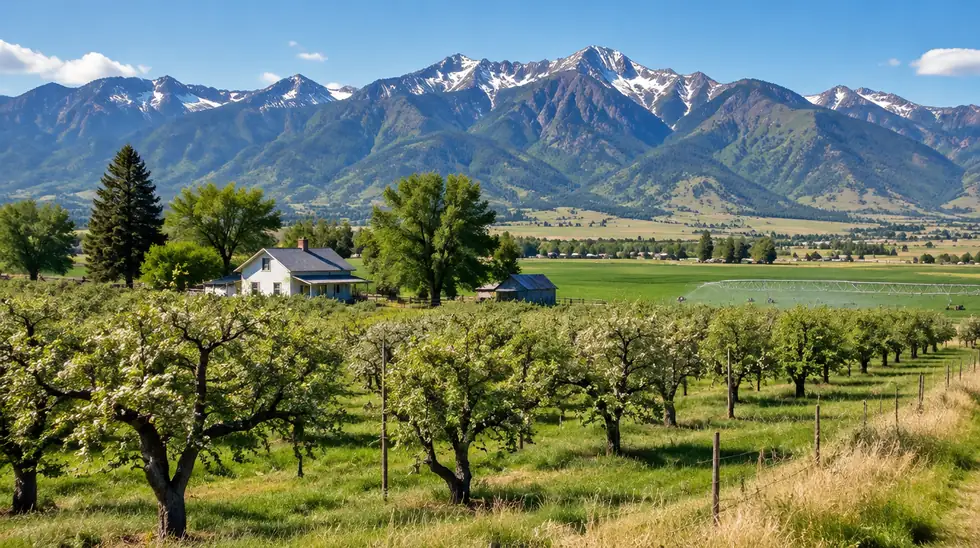
You bought the house in the Bitterroot partly for that view. Then you spent two springs watching the apple tree throw a beautiful set of blossoms in early May, and two springs watching a frost that nobody warned you about take every one of them. The tree is fine. The tree was never the problem.
The problem is that you are trying to grow fruit in the one climate in Montana where fruit actually works, and the thing that decides whether you get a crop here has nothing to do with how cold your winter gets.
It is what the sky does for about ten days in May.
Hamilton sits in a genuinely special piece of country. This is the fruit valley, the warmest zone band in the state outside the Flathead lake shore, and the place where Montana's apple history actually happened. It is also a place where a single frost event separates a full crop from an empty one, and where the single most useful thing you can learn is which side of the valley your ground drains cold air toward. Let's do the numbers first.
Quick facts: what Hamilton gives a plant
| Fact | Hamilton |
|---|---|
| Hardiness zone (2023 USDA map) | 5b–6a |
| Frost-free days | ~130 — approximate, and it varies within the valley |
| Elevation | 3,625 ft |
| Annual precipitation | Not a station in our published table — see the note below |
| Growing region | Western / Missoula & Bitterroot Valleys |
| Defining character | Bitterroot fruit country — and a bloom-frost gamble |
Two caveats before you plan around those numbers. Published frost dates are stated at the 50% probability level, which means half the years you get more than 130 days and half you get fewer, and the figure moves as you drive up or down the valley. Verify your own address at the official USDA tool, planthardiness.ars.usda.gov.
On precipitation, we publish NOAA's 1991–2020 climate normals where we have a station, and Hamilton is not one of the stations in our table. We will not invent a number for you. Check the station nearest your own ground, and treat your own gauge as the figure that actually drives your irrigation.
What those numbers mean for your yard
Hamilton's 5b–6a band is the warmest in the state short of the Flathead lake shore, and it is the reason this valley has grown fruit commercially for well over a century. In a state where most gardeners are fighting a 110-day season, Hamilton gets roughly 130 days and a zone band that lets you attempt things the rest of Montana cannot.
But the zone is not the interesting part. Hamilton's binding constraint is spring frost, not winter cold. A mature apple or plum tree in this valley is not going to be killed by a Bitterroot winter. What will happen, routinely, and to experienced growers as much as to new ones, is that a warm April coaxes the tree into bloom and then a May frost arrives and takes the flowers. No flowers, no fruit.
The tree shrugs it off and tries again next year. That is exactly why people keep planting fruit here, and exactly why so many of them keep being disappointed.
That changes what you do, in three ways:
Site the tree, not just the species. The classic fruit-tree site is a south-facing slope, and it is a classic for a reason: it warms earlier, melts out earlier, and ripens fruit better. But early warming is a double-edged tool in a frost valley, because the earliest ground is also the ground that blooms first. On a slope with good air drainage, the cold air that pools on the valley floor slides past your tree and keeps going. In the bottom, it sits on your blossoms all night. You can watch the whole thing happen without any instrument at all. A clear night, no wind, and the cold pours downhill the way water would, except that water at least stops when it reaches the bottom.
Choose late bloomers. This is the single most consequential plant decision you will make. Where two cultivars of the same fruit are equally hardy, the later-blooming one is worth more to you, every time, because it pushes its flowers past the average last frost instead of into it.
Understand your own air drainage before you plant anything. Walk your property on a clear, still, cold morning in early May. The spots holding heavy frost at 7 a.m. are your frost pockets. The spots already clear, or better, the ground partway up a slope that drained clear first, are where the fruit goes. Same soil, same sun, different crop.
This is the same cold-air-pooling mechanism that shapes every Montana valley, and it is worth understanding properly rather than taking on faith. Our overview of Montana's growing regions explains how the valleys differ from the mountains ringing them.
The history is real, and it is in your backyard
If you are going to garden fruit in the Bitterroot, you should know that you are standing on the oldest orchard ground in the state.
The earliest documented orchard in Montana was planted by Fathers Ravalli and DeSmet near Stevensville in the late 1840s. You will see "1845" repeated all over the internet, and that date is folklore. MSU's own history does not give an exact year, so we do not use it. The commercial era came with the Bass brothers, who planted Pine Grove Farm near Stevensville around 1870, took their first Duchess of Oldenburg crop in 1877, and shipped their first carload of fruit in 1890. The cultivars they worked with are still worth knowing by name: Duchess of Oldenburg, Red McIntosh, Alexander, Northwest Greening, Bethel, and the Transcendent and Hyslop crabapples. There is a warning buried in that history that applies directly to you. The early trees they mail-ordered from Oregon, Washington, Utah, New York and Plymouth, Massachusetts mostly winterkilled. The varieties that survived are the ones that were adapted, not the ones that were fashionable.
That lesson has not changed in 150 years. Buy from a regional nursery that grows its stock in this climate, and take the local recommendation over the catalogue photograph.
What grows here
The fruit list below is the reason this page exists. Every zone figure is the standard horticultural rating, and every note is the reason the plant earns its place in this valley, a different question from whether it will survive the winter.
Fruit
| Plant | Zone | Why it works in Hamilton |
|---|---|---|
| Contender peach | 4–9 | Self-fruitful and late-blooming with frost-tolerant buds — the key trait here. The most realistic peach for this climate, though short-lived. Give it the warmest, most protected site you have |
| Meteor pie cherry | 4–8 | Self-pollinating and hardy to about −40°F. Sour cherries suit a Montana season far better than sweet ones |
| North Star cherry | 4–7 | A genetic dwarf sour cherry, self-fruitful and very cold-hardy. Well suited to a small yard |
| McIntosh apple | 4–7 | One of the more reliable cold-climate apples and well suited to cool summers. Not self-fertile |
| Honeycrisp apple | 3–6 | Realistic in Zone 4 valleys and fine in this one. Not self-fruitful — it needs a second cultivar plus a crabapple polliniser, and expect bitter pit |
| Mount Royal plum | 3–5 | Self-fertile, so a single tree sets fruit. Rated to zone 5, so it is comfortable on the valley's 5b ground and at the warm edge in a 6a pocket — confirm the zone with your supplier before you buy |
Structure, shelter and native backbone
| Plant | Type | Zone | Notes for the Bitterroot |
|---|---|---|---|
| Serviceberry (Amelanchier) | Shrub/small tree | 2–7 | Early white bloom, edible fruit, fall colour. Handles a cold valley without help |
| Chokecherry | Shrub/small tree | 2–7 | Very tough, wildlife food, spreads by root — give it room |
| Black hawthorn | Tree | 4–8 | Thorny cover that handles deer pressure; in the rose family, so fireblight is a risk |
| Rocky Mountain maple | Tree/shrub | 4–8 | Small understory native with real shade tolerance and good fall colour |
| Western larch | Conifer | 4–6 | A deciduous conifer and the best conifer here for defensible space — thick bark, and it drops its needles. Needs deep, moist soil |
| Red-osier dogwood | Shrub | 3–7 | Red winter stems; takes the wetter ground. It spreads by stolons, so it will colonise |
| Common ninebark | Shrub | 3–7 | Tolerates alkaline soil, clay, drought and short seasons |
| Camas | Bulb | 4–8 | A Montana native garden bulb, west of the Divide. Wants spring moisture, then summer drying — it naturalises in a lawn edge |
For the edible ground layer and the flowers around it, add peony, daylily, wild bergamot, showy milkweed, blanketflower and creeping Oregon grape. All of them are comfortable here, and all of them are listed with their zone ranges in our guide to Montana native plants.
Two reminders from MSU's guidance. Never wild-dig natives. Source them from a reputable supplier. And natives need water while they establish, a full season or more for trees and shrubs. "Drought-tolerant" describes a rooted plant, not a newly planted one.
What dies here — and why we would tell you not to plant it
This is the section that saves you money, and in the Bitterroot it is mostly about frost timing rather than hardiness.
Parker pear. Rated 4–8, so it is hardy here by zone, and we would still talk you out of it. It is very susceptible to fireblight, and Montana has had severe fireblight years. It also chloroses on alkaline soil. A tree that survives the winter and then dies of blight in June is not a tree you want in a fruit garden.
Early-blooming sweet cherries in an open site. The Eubank sweet cherry is self-pollinating and rated for this zone, but it is an early bloomer, which puts it squarely in front of the spring frost window. It is a protected-site tree here, not a field tree. If you want a cherry that works, the sour types, Meteor and North Star, are the honest answer, and they are the ones that suit a Montana season.
Reliance peach in place of Contender. Reliance has cold-hardy flower buds, which sounds like the trait you want. But it blooms with the main season. It does not dodge frost the way Contender does, and bloom-time frost, not winter cold, is the binding constraint in this valley. Two peaches with similar hardiness ratings, and only one of them is a sensible Hamilton planting.
Bigleaf hydrangea. Sold everywhere, and the wrong hydrangea for this climate. Bigleaf hydrangea flowers on old wood, so it leafs out in spring and then never blooms after winter dieback. Panicle hydrangea, rated 3–8, flowers on new wood. That single trait is what makes it work here: it blooms reliably even after a hard winter.
Huckleberries in a garden bed. The Bitterroot is huckleberry country, so this comes up constantly, and the honest answer is still no. True huckleberries want a pH near 5.5 and have no tolerance for calcium carbonate, the opposite of what valley-floor soils here generally give you. Those run neutral to slightly alkaline and high in calcium. USDA calls the species "very difficult to establish" at the best of times. Our native plants guide covers the container workaround and its limits.
Juniper in the defensible space. Rocky Mountain juniper is a fine native plant out on the open ground, and it handles wind and drought better than almost anything. It is also highly flammable, a gasoline wick. The Bitterroot's wildland-urban interface is thick with it, which makes this the single most important fire-plant decision a Hamilton-area homeowner makes. The zone-by-zone rules and the fire-resistant species named in Montana sources are in the defensible-space guide, and MCA 33-24-110 lets insurers discount for defensible-space landscaping, while a July 2025 state auditor memorandum bars them from denying or cancelling a policy solely on wildfire risk.
Hamilton against its neighbours
| City | Zone | Frost-free days | Elevation |
|---|---|---|---|
| Hamilton | 5b–6a | ~130 | 3,625 ft |
| Missoula | 5b | ~150 | 3,198 ft |
Here is a comparison that surprises almost everyone. Hamilton is in a warmer zone band than Missoula, 5b–6a against 5b, and yet it gets about twenty fewer frost-free days.
Missoula sits at 3,198 feet and Hamilton at roughly 3,625, and that 400-odd feet of elevation buys Missoula three extra weeks of season and costs Hamilton the same, and it is the reason a frost map will tell you one thing while your own thermometer, hanging on the porch post, tells you something else entirely. The zone map does not capture it at all, because zone is a measure of how cold winter gets, not how long summer lasts. It is the same lesson the rest of this site keeps teaching, from the other direction: in Montana, elevation is the master variable, and the zone band is only one of two numbers you need. If you want to see how the other valley in the western valleys region compares on siting and cold-air pooling, read what grows in Missoula.
The practical takeaway for a Hamilton gardener: you have a longer season than most of the state and a warmer zone band than most of the state, and you will still lose fruit to a May frost if you site the tree badly. Your advantage is real. It is just not unconditional.
Frequently asked questions
What growing zone is Hamilton, Montana?
Hamilton is zone 5b–6a on the 2023 USDA map, one of the warmest bands in the state and second only to the Flathead lake shore. The map is fine-grained and the valley straddles boundaries, so verify your own address at planthardiness.ars.usda.gov.
Can I really grow peaches in Hamilton?
Peaches are the most marginal fruit in this valley, but they are genuinely possible with the right cultivar and the right site. Contender is the pick: self-fruitful, late-blooming, with frost-tolerant buds, planted on your warmest and most protected ground. Expect it to be short-lived. Avoid early-blooming types that cannot dodge a May frost.
Why did my apple tree bloom beautifully and then produce no apples?
A spring frost took the flowers. That is the binding constraint in the Bitterroot, not winter cold, and it is why siting and bloom timing matter more here than hardiness ratings. Plant partway up a slope so cold air drains past the tree, and choose late-blooming cultivars.
Can I grow huckleberries in my yard?
Not reliably. True huckleberries want a pH near 5.5 and cannot tolerate calcium carbonate, the opposite of what this valley's ground generally gives you. See the guide to Montana native plants for why the hills, not the garden, are where you get them.
When should I plant a tree in the Bitterroot?
September is the best month for transplanting a tree anywhere in Montana. The soil is still warm, the air is calmer, and roots get a full autumn to establish before the ground freezes. And whatever you plant, water it through its first full season: "drought-tolerant" describes a rooted plant, not a new one.
The honest summary
Hamilton is the best fruit ground in Montana, and it will still punish a careless planting. Pick cultivars that bloom late, put them partway up a slope where the cold air drains away, understand that your real enemy is a May frost rather than a January one, and buy your stock from someone who grows it in this climate. Do that, and the tree that has been teasing you for two springs will finally hold a crop.
Wondering how your ground compares to the rest of the state? Find your Montana growing region.
And when the air drainage, the grading, the fence line and the irrigation all sound like work you would rather hand to someone who has planted in this valley for years, that is a reasonable call. Get matched with a vetted Hamilton landscaper, or compare what landscaping actually costs in Montana before you take bids.
What to read next
Montana Growing Zones Explained: What Actually Grows Where You Live
Climate & Zones · 16 min read
When to Plant in Montana: A Month-by-Month Guide for a Short Season
Climate & Zones · 18 min readMontana Frost-Free Days by City — and Why Your Neighbor’s Is Different
Climate & Zones · 10 min read
The Best Trees for Montana: What Survives the Wind, the Cold, and the Alkaline Soil
Plants · 18 min readMontana Native Plants for Landscaping: 40+ Species That Belong Here
Plants · 15 min read