Growing conditions in Missoula, Montana
Missoula, Montana
Missoula & Bitterroot Valleys region · Western Montana
- USDA hardiness zone
- 5b
- Frost-free days
- ~150
- Elevation
- 3,198 ft
- Annual precipitation
- 14.1"
- Region zone band
- 5b – 6a
- What defines it
- Cold air pools on the valley floor
Zone from the 2023 USDA Plant Hardiness Zone Map. Frost-free days are an approximate single-station estimate at roughly the 50% probability level and vary within a town. Precipitation is a NOAA 1991–2020 normal.

You planted the flowering cherry in the low back corner because that's where it looked best against the fence. It died the first winter. Your neighbor set the same tree fifteen feet up the slope behind the shed, and theirs is fine.
That isn't luck. It isn't a bad nursery tag either. Missoula is a cold-air-pool valley, and in a cold-air-pool valley fifteen feet of elevation changes what survives. Almost no landscaping site in the country explains this. It is the single most useful thing you can know about planting here.
Quick facts: what Missoula actually gives a plant
| Hardiness zone | 5b, straddling 5b and 6a (2023 USDA map) |
| Elevation | 3,198 ft |
| Frost-free days | Roughly 150 — approximate, and it varies street by street |
| Annual precipitation | 14.1 inches (NOAA 1991–2020 climate normals) |
| Soils | Heavy glacial-lakebed clays in parts of the valley; valley floors neutral to slightly alkaline and high in calcium |
| Signature constraint | Cold-air pooling (inversion), not season length |
| Signature hazard | Wildfire in the surrounding wildland-urban interface |
One caveat before you plan anything around that 150-day figure: published frost dates are usually stated at the 50% probability level. Half the years you get more, half you get less, and the number shifts between a bench above town and a bottomland pasture a mile away. Check your own address at the official USDA tool rather than trusting a city-wide average, and read the statewide picture on Montana frost dates before you commit a tender plant to the ground.
Missoula is a cold-air-pool valley — and that decides your planting plan
Here is the mechanism, and then the practical rule.
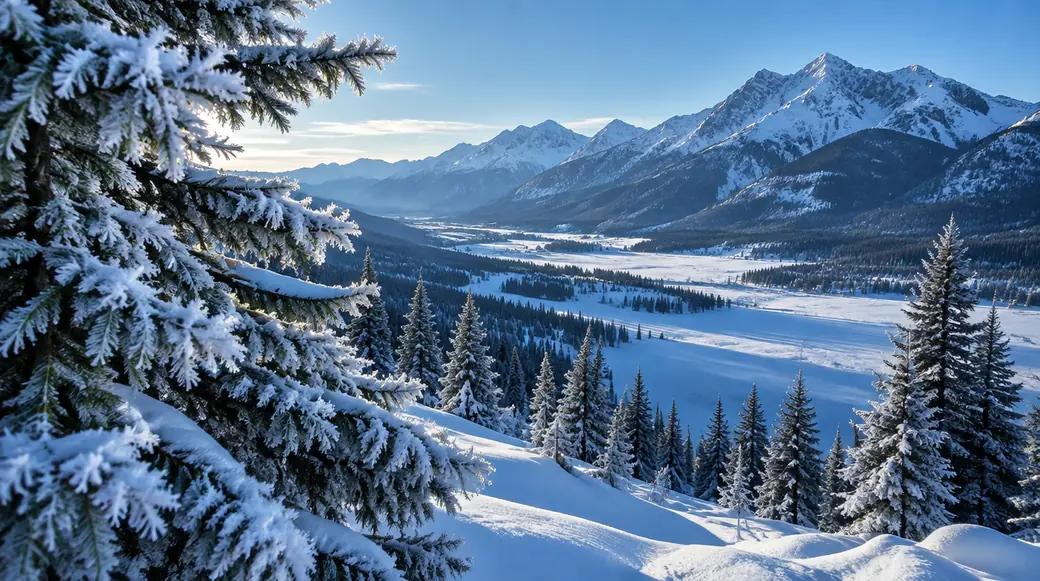
You can watch it happen on any clear January night: the air touching the ground cools first, and because cold air is denser than the warm air above it, that chilled layer slides downhill off the slopes of the surrounding mountains, gathers in the draws, and runs out onto the valley floor where it pools like water in a bathtub and sits there until morning. The result is a temperature inversion, and the valley bottom is colder at night than the ground a hundred feet above it. Missoula is a textbook example, one of the clearest inversion valleys in the state.
The practical consequence is blunt: frost-sensitive plants belong partway up a slope, not in the bottom. That low, flat, easy-to-water corner of your yard, the one that looks like the obvious place for a fruit tree, is where cold air sits all night. The rise behind the shed, even a gentle one, drains that cold air away. Same soil, same sun, different microclimate. Homeowners in Missoula lose more plants to siting than to species choice. A tree that is fully hardy for Zone 5b can still be killed in a bottomland frost pocket it had no business being planted in.
The thermal belt: where Missoula's tender plants actually live
Above the pooled cold air there's a band that stays warmer all winter, the thermal belt, the mid-slope zone that sits on top of the inversion layer. This is where Montana's orchards have always gone. It's where you should put anything that runs up against the edge of its hardiness rating: the peach you want to try, the Japanese maple, the late-blooming shrub that keeps getting nipped.
Read the land before you read the plant tag.
Walk your property on a clear, still, cold morning in January. The places where the frost is thinnest, or where nothing has frosted at all, are your thermal belt. Those are the spots for your marginal plants. The spots with the heaviest frost, the frost that lingers after the sun is up, are your frost pockets, good for the toughest natives and for nothing tender. This is also why a Missoula gardener's second-most-valuable tool, after a soil test, is a walk around the yard at 7 a.m. in February.
Which Missoula gardener are you?
The native-plant purist. You moved here for the landscape and you're not interested in recreating a Midwest lawn. "We don't do Kentucky bluegrass" is a real position in this town, and it's a defensible one. Missoula's climate is genuinely kind to a native palette, and this is the easiest place in Montana to build a yard that looks like Montana. Start with our guide to native plants for Montana gardens.
The transplant newcomer. You arrived from somewhere wetter and greener, you have a Zone 6 plant list in your head, and last spring cost you three shrubs. None of that makes you a bad gardener. It makes you new. The corrections are small and they take one season to learn: siting, soil, water.
The wildfire-zone homeowner. You live up one of the valleys, the Bitterroot, the Blackfoot, the Seeley-Swan, the Rattlesnake, and your real landscape question isn't beauty, it's whether your plantings help or hurt when a fire comes. The 2023 fire season made that vivid for everyone in western Montana. Skip ahead to the defensible-space section; it's written for you.
Soils: the Glacial Lake Missoula clay problem
Parts of the Missoula Valley floor are underlain by heavy clays left by Glacial Lake Missoula, the ice-dammed lake that filled this valley and left its sediment behind when it drained. Those clays are the reason a hole in your yard can hold water like a bucket. They drain poorly and they aerate poorly. That is hard on the roots of almost everything, and worst on plants that need sharp drainage.
Where the soils aren't clay, the valley floors generally run neutral to slightly alkaline and are high in calcium. That is the part that rules out a whole class of plant you may have grown before. Western Montana soils tend more acidic than the state's eastern half, so a soil test beats an assumption either way. The calcium ties up phosphorus. Above about pH 8.3 it can lock out phosphorus, potassium, iron, zinc and manganese. The visible symptom is iron chlorosis, yellow leaves with green veins. MSU Extension lists apple, maple and poplar among the species most prone to it. The tolerant list is longer than most people expect. Linden, ash, boxelder, oak, elm, hawthorn and honeylocust all handle it better.
Do not plan on "fixing" the pH. MSU Extension cites roughly 10,000 pounds of elemental sulfur per acre to move pH from 8.0 down to 7.5. That is not a home-garden project. The answer is always to choose pH-adapted species, and on the clay, to amend and mound your planting beds so roots sit above the water table, not in it.
If you're seeing yellow foliage across the yard, that's a separate diagnosis. Start with why a Montana lawn goes yellow before you assume it's one thing.
Missoula landscaping: what actually grows here
Every plant below carries a zone range assigned in MSU Extension's 2025 MontGuide, Native Plants for Montana's Home Gardens, and every one is native to this part of the state. Each of them already knows how to handle a cold-air valley, alkaline soil and a dry August.
| Plant | Type | Zone range | Notes for Missoula |
|---|---|---|---|
| Serviceberry (Amelanchier) | Shrub/small tree | 2–7 | Early white bloom, edible fruit, fall color |
| Chokecherry | Shrub/small tree | 2–7 | Tough, wildlife food, spreads by root |
| Red-osier dogwood | Shrub | 3–8 | Red winter stems; wants the wetter spots |
| Common ninebark | Shrub | 2–8 | Shredded bark, white flowers; very durable |
| Golden currant | Shrub | 3–8 | Yellow bloom, fragrance, drought-tough |
| Snowberry | Shrub | 3–7 | White berries, spreads to make a thicket |
| Woods' rose | Shrub | 3–8 | Single pink bloom, hips for the birds |
| Ponderosa pine | Tree | 3–7 | The valley's signature conifer; needs room |
| Douglas-fir | Tree | 4–6 | Slower, denser, a good screen |
| Rocky Mountain maple | Tree/shrub | 4–8 | Fall color — but see the iron-chlorosis note |
| Black hawthorn | Tree | 4–8 | Thorny, wildlife cover, good under pressure |
| Kinnikinnick | Groundcover | 2–6 | Evergreen mat; wants sharp drainage |
| Blanketflower | Perennial | 3–10 | Long bloom, thrives on neglect |
| Showy milkweed | Perennial | 3–8 | Monarch host; give it room |
| Wild bergamot | Perennial | 3–8 | Late bloom the pollinators work hard |
| Bluebunch wheatgrass | Grass | 3–7 | The backbone native bunchgrass |
| Idaho fescue | Grass | 4–8 | Fine-textured, semi-evergreen clump |
The best trees for a Montana yard get a fuller treatment, including the ones that want the thermal belt rather than the valley floor.
Two notes on the MSU guidance, both of which catch people out. First: never wild-dig your natives. Source them from a reputable supplier; digging from the hillside damages the stand and is often illegal on public land. Second, and this is the mistake MSU names most often: natives still need water while they establish, a full season or more for trees and shrubs. "Drought-tolerant" means it survives once it's rooted. It does not mean it survives being ignored in its first summer. Late-fall seeding is optimal for many of the forbs and grasses, because they need cold stratification to germinate.
What dies here, and why
This is the part most landscaping content skips, and it's the part that saves you money.
Rhododendrons and blueberries. Both of them want acid soil, and that is the wrong order for this valley. Missoula's valley-floor soils run neutral to slightly alkaline, and the clay compounds the drainage problem. You can keep either alive in a container with a purpose-mixed acid medium. In the ground they will yellow, stunt and eventually fail, not because you did something wrong but because the soil is the wrong chemistry and the correction is impractical.
Huckleberries in the garden. Montana's state fruit wants a pH near 5.5 and has no tolerance for calcium carbonate, so it will not grow in this valley's ground. The native plants of Montana guide explains why, and why serviceberry and chokecherry are the honest substitute for berries.
Anything tender planted in the valley bottom. Covered above, and it's the most common expensive mistake in this city because the siting looks right even when it isn't.
Wildfire in the Missoula valleys
Montana ranks second nationally for the share of homes at catastrophic wildfire risk, and the valleys around Missoula are thick with the wildland-urban interface, the boundary where houses meet flammable country. If you live out the Bitterroot, up the Blackfoot, in the Seeley-Swan or along the Rattlesnake, your landscaping plan and your survivability plan are the same document.
The one plant fact that matters most: juniper is highly flammable. Keep it out of your defensible space. It's a popular ornamental, it's sold in every nursery in the state, and in fire country it's a gasoline wick. This is the single most important fire-plant decision a Missoula-area homeowner makes. The rest is structure, and the zone-by-zone rules and the fire-resistant species named in Montana sources are all in the full defensible-space guide for Montana. The one Missoula-specific note: plants survive fire better when they are succulent and well-watered, which is easier to manage in a valley with a real irrigation season. There's a financial angle nobody mentions. Montana law, MCA 33-24-110, lets insurers discount for defensible-space landscaping. A July 2025 state auditor memorandum bars insurers from denying or cancelling coverage solely because of wildfire risk. Landscaping for defensible space is protection you can be paid for. The full defensible-space guide for Montana walks through the zones plant by plant.
Living with a long season — and the weeds that come with it
Missoula's roughly 150 frost-free days are among the longest in Montana. That's genuinely good news: it's a real vegetable season, and it's the reason a warm-season garden is possible here in a way it isn't at elevation elsewhere. It also means the growing season for plants you don't want is just as long.
Noxious weeds are a legal matter in Montana, not just an aesthetic one. Under MCA 7-22-2116 it is unlawful to permit noxious weeds to propagate or go to seed on your land. The county sends a certified-mail notice, the owner has ten days to respond, and if they don't comply the county can do the work and bill cost plus a 25% penalty. Common buckthorn, Priority 2A since 2017 and reported in 27 Montana counties, is a shrub homeowners planted for decades before anyone understood what it did. If you're not sure what's coming up in your beds, the noxious weeds of Montana guide has the current status categories, and the distinction matters: Norway maple and Siberian elm are not on Montana's noxious list, while Russian olive and saltcedar are Priority 3.
If you want a lower-maintenance, lower-water yard, the direction a lot of Missoula gardeners are already heading, the honest starting point is xeriscaping in a Montana climate.
A note on water
Missoula is a place people assume has all the water it needs, and it's true that 14.1 inches of precipitation is well above what Helena or Dillon sees. But Montana water law runs on prior appropriation, first in time, first in right, and in a shortage a junior user can be cut off regardless of what falls on their roof. If you're irrigating from a well on acreage, the exempt-well thresholds are the ones to know. Xeriscaping in a Montana climate lays out where a normal yard fits and where a big lawn plus new landscaping can cross the line, a conversation to have before you break ground, not after.
Frequently asked questions
What zone is Missoula in for planting?
Missoula is Zone 5b on the 2023 USDA map, straddling 5b and 6a, on the warmer side of the state. The map is fine-grained and a city can sit across two zones. Verify your own address at planthardiness.ars.usda.gov rather than relying on a city-wide figure.
Why do my plants die in the low part of my yard but not up the slope?
That's cold-air pooling. Dense cold air drains downhill and settles on the valley floor, so the bottom of your property is colder at night than the ground a little above it. Move frost-sensitive plants partway up a slope and out of the pocket.
Can I grow huckleberries in my Missoula yard?
Not reliably, and anyone who tells you otherwise is selling something. Huckleberries want a pH near 5.5 and cannot tolerate calcium carbonate. The native plants of Montana guide covers the container workaround and its limits.
How long is the growing season in Missoula?
Roughly 150 frost-free days, one of the longer seasons in Montana. But it's an average published at the 50% probability level, and it varies within the city, so plan around your own site rather than the number.
Does landscaping really affect my wildfire insurance?
Montana law allows insurers to discount for defensible-space landscaping, and a 2025 state auditor memorandum bars insurers from denying or cancelling solely on wildfire risk. The defensible-space work is worth doing for the protection first and the discount second.
The bottom line for Missoula
Missoula is not a hard place to garden. It's a place where the location of the garden matters more than the plant list, and once you understand the cold-air pool, most of the mystery goes away. Plant the tough natives across the bottom, put your marginal plants in the thermal belt, keep juniper away from the house, and amend the clay so roots aren't drowning. That's the whole playbook.
And when you'd rather hand the excavator, the drainage and the fence line to someone who has done it in this valley a hundred times, that's a fine decision too.
Get matched with a vetted Missoula landscaper, or compare what landscaping actually costs in Montana before you take bids. If you're in the Flathead instead, start with what grows in Kalispell; for the statewide picture, Montana's growing regions put your valley in context.
What to read next
Montana Growing Zones Explained: What Actually Grows Where You Live
Climate & Zones · 16 min read
When to Plant in Montana: A Month-by-Month Guide for a Short Season
Climate & Zones · 18 min readMontana Frost-Free Days by City — and Why Your Neighbor’s Is Different
Climate & Zones · 10 min read
The Best Trees for Montana: What Survives the Wind, the Cold, and the Alkaline Soil
Plants · 18 min readMontana Native Plants for Landscaping: 40+ Species That Belong Here
Plants · 15 min read