Montana Frost-Free Days by City — and Why Your Neighbor's Is Different
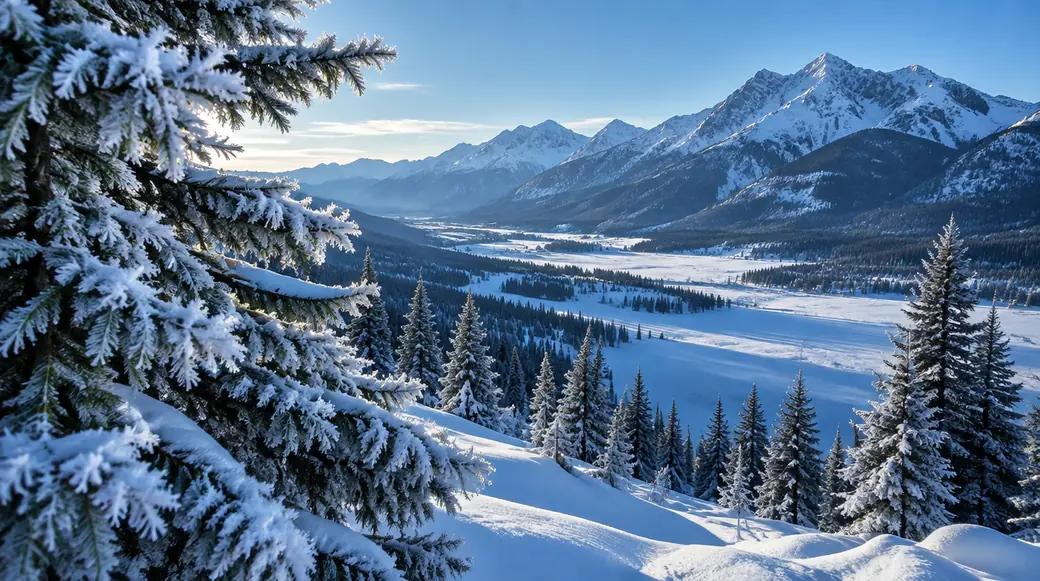
Your first frost date is not a state number.
It is a spot on your property.
Ask ten gardeners in the same Montana town when the last frost hits and you'll get three answers and an argument. Frost doesn't fall evenly across a zip code. It settles. It drains downhill and pools, it finds the low ground and the open ground, and it leaves the sheltered slopes alone.
The single "Montana frost date" you'll find online doesn't exist. What exists is a date for one weather station, standing in one field, standing in for a hundred square miles of ground that doesn't behave the same way.
So settle one thing up front: actual first and last frost dates vary too much street by street to list responsibly for a whole state. This page works in frost-free days instead, the dependable measure of how much season you have, and then shows you how to read your own ground for the dates.
Here is what the stations actually record, plus something more useful: how to read your own ground so you plant to your real last frost instead of the town's rough average.
Montana frost dates and frost-free days, by city
The most practical number isn't a date at all. It's your frost-free days, the count of days between your last spring frost and your first fall frost, and that count is the length of your growing season: it tells you whether a tomato will ripen before September.
Approximate frost-free days by city, shortest season to longest:
| City | Approx. frost-free days |
|---|---|
| Butte | ~92 |
| Kalispell / Columbia Falls | ~110 |
| Livingston / Red Lodge | ~116 |
| Belgrade | ~120 |
| Bozeman | ~126 |
| Hamilton | ~130 |
| Havre | ~136 |
| Whitefish | ~138 |
| Lewistown | ~143 |
| Sidney | ~144 |
| Helena | ~149 |
| Billings / Missoula | ~150 |
| Miles City | ~151 |
| Great Falls / Polson | ~155 |
| Glendive | ~160 |
Source: approximate frost-free-day figures are single-station estimates reported at roughly the 50% probability level. Elevation and cold-air pooling can change the answer within a single city — treat these as the middle of a window, not a guarantee.
Read the top and bottom of that table and the whole argument for this page is right there. Butte gets about 92 frost-free days. Glendive gets about 160. That's more than two extra months of growing between two towns in the same state, and the reason isn't latitude. Butte sits at 5,539 feet and Glendive at 2,053, and since temperature drops roughly three to five degrees per 1,000 feet of climb, the 3,500 feet between them shrinks the season accordingly.
Our full guide to Montana growing zones explains why elevation, not how far north you are, decides your season, and it works through the counterintuitive case of Red Lodge having a shorter growing season than Havre, a town that sits 230 miles closer to Canada.
But before you plan a single planting date around that table, read the next section, because the table has a catch.
The caveat that matters more than the table
Every number above is a single-station estimate: one weather station's record, averaged over years, reported at roughly the 50% probability level. That means it's a coin flip.
A "last frost date" published for your city is the date by which frost has passed in about half of recorded years and has not in the other half, so the number you plan your whole garden around is a bet that this spring will behave like the average spring, and the average is built out of the springs that did not behave.
Three things to hold onto:
- These are estimates, not guarantees. Treat every date as the middle of a window, not a line drawn under your season.
- They vary within a city, sometimes within a few blocks. Two gardens a mile apart can carry different effective frost dates, because frost follows terrain and terrain changes fast.
- They vary by elevation and by shelter. A station on the valley floor and a garden on the slope above it don't see the same last frost, even though they share a zip code.
Use the table to know roughly how much season you have, and use the next two sections to read your own ground for when that season actually starts and ends.
Why your valley bottom frosts first
The frost fact that costs the most plants is the narrow version of a bigger story.
Cold air is heavy. It drains downhill at night and pools in the low spots. So the coldest place on your property on a frosty night is not the highest ground or the most exposed ground. It's the bottom: the valley floor, the low corner by the ditch, the flat pocket behind the shop. That's where frost lands first in fall and last in spring.
The practical rule, worth taping to the inside of your shed door:
Plant frost-sensitive plants partway up a slope, not at the bottom.
That flat, sheltered-looking spot at the low end of the yard, the one that seems so inviting, is usually the coldest ground you own. We take the full microclimate treatment, south slopes, thermal belts, lakeshores, urban heat, on our page on Montana growing zones, because it drives more than frost. Here, hold onto the one rule: the low ground frosts first.
If all your ground is flat, you still have moves, and none of them require a different property. Plant tender crops against a south-facing wall. Use raised beds for warmer soil, better drainage, and a few degrees of margin. Lean on row cover through the shoulder weeks. Those aren't garden clichés in Montana. They're how you buy back the frost margin your land doesn't hand you for free. And every one of them costs less than losing a planting.
Why the last frost matters more than the first
Gardeners tend to worry about both frost dates equally. In Montana, the spring one deserves more of your attention.
The last spring frost sets your planting date. It's the gate you wait behind before tender crops go in the ground: tomatoes, peppers, squash, beans. Set them out too early and a single late frost takes the whole planting, and that is the mistake that eats a Montana vegetable garden almost every year. The warm week in May tricks you into planting, and then the frost punishes you for believing it.
The first fall frost mostly ends the season you already had. By the time it arrives, your warm-season crops are finishing anyway. It matters if you're pushing a late crop or nursing something to full ripeness, and it matters a lot in the mountains, where it can come in early September. But it rarely costs you as much as a spring frost does.
The safe approach for the spring gate: know your last-frost estimate, then wait a week or two past it before you set out tender plants without protection, unless you're ready to cover them. Pushing your planting two weeks early into a 50%-probability date is a coin flip on a crop you've watered for six weeks.
Waiting is free.
For the full season sequence, when to start seeds, when to harden off transplants, when it's safe to direct-sow, see our guide to when to plant in Montana, which turns these dates into a month-by-month calendar.
A light frost is not a hard freeze
"Frost" covers two very different events. And the difference decides what survives, so when you read a forecast, read it for which one is coming.
A light frost, an air temperature of roughly 28 to 32°F on a clear, calm night, is a warning shot. It can nip the tops of tender plants, blacken a basil leaf, and leave the rest of the plant alive. Hardy crops shrug it off entirely, and tender plants may come back from it, especially if you cover them or the sun comes up gently.
A hard freeze, 28°F or below for several hours, often with wind, is not a warning. It freezes the water inside plant cells and kills tissue outright. It ends the season for anything tender, and it is the event that turns a garden black overnight.
That distinction is why the plant tiers matter. In Montana, crops sort into four groups by what they tolerate:
- Very tender (damaged below 40°F): cucumber, eggplant, melon, pepper, pumpkin, squash.
- Tender (killed at 32°F): beans, corn, tomato.
- Half-hardy: beet, broccoli, cabbage, carrot, cauliflower, chard, onion, radish.
- Hardy: asparagus, kale, lettuce, pea, potato, rhubarb, spinach.
You can push a hardy crop weeks past your last frost and it won't care, but push a very tender one and you're gambling on a microclimate you probably don't have. Plant each crop to its own tier, not to one calendar date for the whole garden.
Know which plants shrug off the cold and which don't. Our guide to native plants of Montana lists species rated for the state's zone bands, the perennials that were built for a Montana frost, and planting those means you're not gambling every spring on plants that were never going to make it here anyway.
The two extremes: Polson and Butte
If you want the range of Montana's growing season in two towns, look at these.
Butte, about 92 frost-free days. The state's shortest season in this table, and the elevation does it: 5,539 feet up in the Rocky Mountains. A Butte gardener works with three months and change, plans around a hard early frost, and leans hard on cool-season crops and protection for anything tender. Grow the plants that fit the season instead of fighting for the ones that don't. That's the Butte moving strategy.
Polson, about 155 frost-free days. Among the state's longest, and the reason is as much the lake as the elevation. Polson sits at 2,930 feet on Flathead Lake, whose water is a heat battery that warms the shore all autumn, and Polson records the latest average first fall frost of any of Montana's major cities. The lakeshore communities around it, Big Arm, Finley Point, Rollins, reach the warmest zone classifications in the state. That's why the Flathead Valley can grow tender things the rest of Montana can't.
That's a 63-day gap between two Montana towns, nearly nine weeks of growing. It's the clearest possible proof that no single frost date covers this state, and that your own ground is the only number worth planting by.
Frequently asked questions
When is the first frost in Montana?
There's no single date; it depends entirely on where you are. The first fall frost lands earliest in the coldest, highest, and lowest-lying spots, and a valley bottom in Butte or Red Lodge can frost weeks before the slope above it, while the latest frosts come along Flathead Lake, where Polson has the latest average first frost of the major cities. Use your own city's estimate as a window and adjust for your ground.
How many frost-free days does Montana get?
Roughly 90 to 160 days, depending on elevation. Butte and Red Lodge are near the short end (~92 and ~116 days), while Glendive and Polson are near the long end (~160 and ~155). Elevation is the master variable, and the higher your ground, the shorter your season, regardless of how far north you are.
Are Montana frost dates exact?
No. Published dates are single-station estimates reported at roughly 50% probability, and they vary within a city and across a single property. Treat them as the middle of a window, not a guarantee, and add a week or two of margin before setting out tender plants.
Why is my garden colder than the forecast says?
You're probably in a frost pocket, low ground where cold air drains and pools at night, and valley bottoms are colder than the slopes just above them. Plant frost-sensitive crops partway up a slope, not at the bottom, and use raised beds or row cover if your ground is flat.
What's the difference between a light frost and a hard freeze?
A light frost, about 28–32°F, may nip tender tops without killing the plant. A hard freeze, 28°F or below for several hours, kills tender tissue outright and ends the season for warm-season crops, and it will take tomatoes, beans, and squash regardless of how healthy they look the day before.
Should I plant before my last frost date?
Only if you're prepared to protect what you plant. The last-frost date is a 50/50 bet, so planting tender crops before it, without cover, loses about half the time. Hardy and half-hardy crops can go out earlier, while tender and very tender crops should wait until a week or two past your average last frost.
Grow the season you actually have
Frost is not a state number. It's a spot on your ground: a low corner that frosts a week early, a south slope that frosts a week late, a lakeshore that hangs onto warmth the rest of the state gives up in September.
Learn your frost-free days from the table, correct them for your slope and shelter, and plant one cautious week past your last-frost estimate until you know your ground by experience. That's how Montana gardeners stop losing spring crops and start growing the season they actually have.
Not sure what will grow where you are? Find your Montana growing region.


