Winter Burn in Montana: Why Your Evergreens Turn Brown (and How to Stop It)
In October it was a blue-green spruce, dense and healthy, and you'd already pictured it at twenty feet. By February the south side is straw-colored, not dead in any obvious way but tan, as if it had been dipped in something, and the north side of the same tree is still green.
If that's your tree, you didn't kill it.
What happened to it is one of the few landscape problems in Montana with a clean explanation and a real fix.
What actually happened
Start with the fact about evergreens that surprises almost everybody who hears it. They don't stop working in winter. A dormant deciduous tree drops its leaves and shuts down for the season. An evergreen keeps its needles, keeps its stomata, and keeps right on transpiring through the coldest weeks of the year. It loses water out of its foliage all winter long, whether or not there is any water down in the soil to replace what it gives up. In summer that arrangement works fine. The roots pull water out of the soil just about as fast as the needles let it go. A Montana winter breaks the arrangement. The soil freezes, and the roots are locked in ice while the needles keep handing water to the dry air with no way to replace a single drop.
Add the conditions Montana specializes in and the loss accelerates. Warm, sunny, windy days are the accelerant, and a chinook or even one bright January afternoon on a south-facing slope raises leaf temperature, opens the stomata wider, and drives transpiration up while the root zone stays frozen solid underneath.
The plant desiccates from the top down.
And that's why the damage never comes evenly. It shows worst on south and west exposures, the sunny, warm sides, because those are the surfaces pushed into transpiring on days the roots can supply nothing. The shaded north side of the same tree often comes through nearly untouched.
Walk around the trunk and you can read which way the weather came from.
MSU Extension calls the whole category winter injury or winterburn. If you read one line of this page, make it this one. The browning isn't the cold killing the foliage. It's the plant dying of thirst in the middle of a frozen winter.
The Montana multiplier: chinook winds
Every northern state gets some winter desiccation. Montana gets a worse version, and Montana's version has a name.
Chinook winds are warm, dry downslope winds that pour off the mountains and across the plains, raising the temperature dramatically in midwinter while carrying almost no moisture, and for an evergreen that combination is the worst weather there is: warm enough to open the stomata and drive transpiration, dry enough to pull water out of a needle fast, windy enough to strip that water away, and sitting on frozen ground that can resupply nothing.
They move, too.
Chinook country is specific, and if you live in it you already know it. The hardest-hit band runs along the Rocky Mountain Front through Browning, Cut Bank and Choteau, and continues east and south through Great Falls and Havre. If your town sits inside that corridor, winter burn in Montana isn't a risk you might face someday. It's an annual event, and your planting choices should assume it.
"Red belt" injury
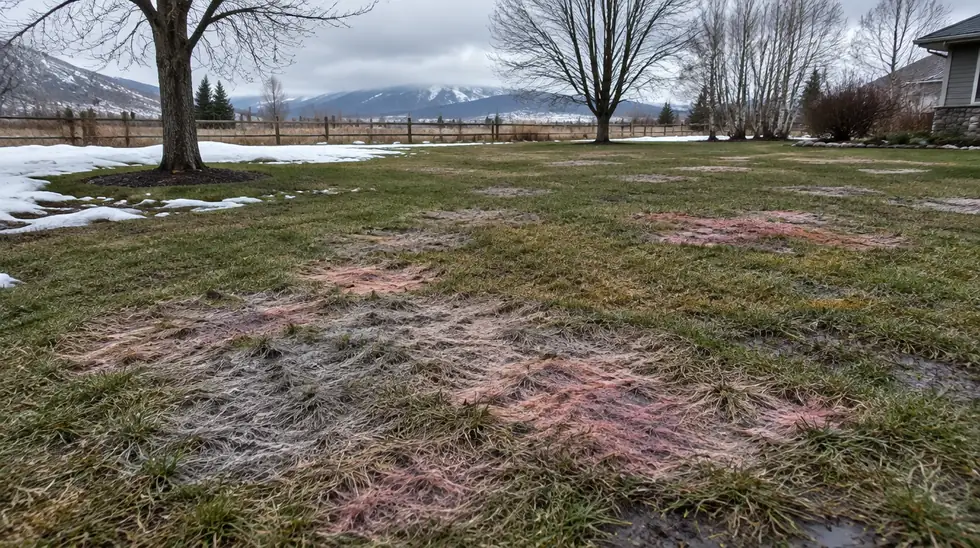
Conifers carry a second, related winter problem that MSU Extension names. "Red belt" injury turns conifer foliage reddish-brown in bands after a hard winter rather than drying it to straw. It is a foliage-level winter injury response and not a disease you can spray for, and like desiccation it shows worst on the exposed side of the tree. If what you're looking at is rusty red instead of tan, and the pattern follows the weather side, that's the category you're in. The treatment doesn't change, so protect it before next winter and assess the real damage in spring.
Which plants are most vulnerable
Not everything in your yard carries the same risk. But the list is short and specific.
Broadleaf evergreens are the worst off. Conifer needles are built for this: waxy cuticles, sunken stomata, a shape that sheds wind. Broadleaf evergreens hold thin, broad leaves through winter with far less protection, and they lose water faster than anything else on the property. Kinnikinnick and the other broadleaf evergreens sold in Montana are the ones to watch most closely. Most of them are also marginally hardy here to begin with, which compounds the problem.
Young and newly planted stock is next. A nursery-fresh tree has a fraction of the root system of an established one, and a smaller root system means less water it can reach even when the soil isn't frozen. Anything planted late in the season is at the top of this list. It never had time to root before the ground locked up, so it goes into winter already behind. That's the practical reason to plant trees in September and not October, as laid out in the Montana planting calendar.
Anything at the edge of its hardiness range is in trouble. Grow a zone 5 plant in a zone 4b yard and winter burn is the first symptom, winterkill the next one. Check your real zone for the spot you're planting rather than the tag on the pot. The Montana growing zones explainer has the city table and the microclimates that override it.
Anything on an exposed site, and that means ridge tops, open ground and west-facing walls, takes it hardest. A windbreak on the upwind side is one of the highest-value things you can build on a rural place, and it traps snow for moisture as a bonus.
One diagnosis note before you assume that desiccation is what you're looking at. Deer browse can look like winter burn at a glance, so check the branch tips. Gnawed and torn means a deer problem and not a winter problem, and the deer-resistant plants guide covers the fix.
The prevention protocol
The good news is that this injury is preventable and the steps are concrete. Do them in order of how much they matter.
1. Deep fall watering, right up until the ground freezes. This is the single biggest lever on the whole list, and it costs nothing at all. A plant that goes into winter fully hydrated can afford to lose some water. But a plant that goes in dry starts the winter already behind and has nothing to draw on. Water deeply through fall, and keep watering until the soil actually freezes, not until the first frost. That's a different and much earlier date. Newly planted trees and shrubs get the most benefit.
2. Water during winter thaws. On a mid-winter warm spell, when the soil has thawed at the surface and the air is above freezing, water again at midday so it soaks in instead of running off frozen ground. This matters most in a low-snow winter, because snow cover is what normally keeps evergreens supplied.
3. Screen the wind and the sun, with fabric and never plastic. Burlap or a snow fence on the south and west sides of a vulnerable evergreen breaks the wind and shades the foliage just enough to stop the transpiration spike without sealing the plant off. Do not wrap evergreens in plastic. Plastic doesn't breathe. It traps moisture against the needles, it can freeze to the foliage, and on a sunny day it turns the wrap into a greenhouse that cooks the very plant you were trying to protect. Burlap breathes. Plastic does not. That distinction is the most common mistake made in this exact situation.
4. Anti-desiccants, with realistic expectations. Anti-desiccant sprays coat foliage in a waxy film that slows water loss. They're most useful on broadleaf evergreens, the most vulnerable group, so apply in late fall above freezing and expect to reapply as the coating wears off. The evidence on conifer needles is mixed, and for a spruce, water and a windbreak matter more than the spray. Landscape crews do this every fall if you'd rather hand it off, and the Montana landscaping cost guide covers what seasonal services run here.
5. No late-season pruning and no late-season fertilizing. Both push new growth, and new growth produced in August or September doesn't have time to harden off before the freeze. That soft tissue dies first and takes the plant's winter hardiness down with it. Stop pruning woody plants in August and don't fertilize them in fall. This is one rule serving two problems at once, and it's the reason the pruning calendar says what it says.
6. White protection for sunscald on thin-barked deciduous trees. Different problem, same season, and it's worth handling in the same pass. On a cold winter day, sun on the south or west side of a trunk can warm the bark enough for cells to break dormancy, and then the temperature crashes after sunset and the tissue dies. Thin-barked species like maples and young fruit trees are the vulnerable ones. The fix is to wrap the trunk in white tree wrap or paint it with white latex, diluted, on the trunk only and never the foliage. White reflects the sun and keeps the trunk temperature steady through the day-night swing. Wrap in fall, remove in spring.
| Protection method | What it fixes | The catch |
|---|---|---|
| Deep fall watering until ground freezes | The root cause — water supply | None. Highest value, no cost |
| Burlap or snow fence on south/west | Wind and sun driving transpiration | Must breathe — never substitute plastic |
| Anti-desiccant spray | Slows water loss from foliage | Needs reapplication; mixed results on conifers |
| No late pruning or fertilizing | Prevents soft growth that winterkills | Requires stopping in August |
| White wrap or white latex paint | Sunscald on thin-barked deciduous trunks | Trunk only, remove in spring |
| Windbreak / shelterbelt | Desiccation, snow catch, soil temperature | Takes years to establish |
Frequently asked questions
Will a browned evergreen come back?
Sometimes, and spring will tell you. Needles that browned from desiccation are dead and won't green up again, but the buds behind them may have survived, and if they did, the tree pushes new growth and fills back in. Don't prune the brown out in winter. Wait until spring growth starts, then prune back to live wood so you can tell dead tissue from live by where the tree is actually growing. If the terminal leader and the buds are dead all the way down, the tree is gone.
Can I prune the brown branches off right now?
No. Prune in spring, after growth restarts, so you can cut back to live wood instead of guessing in February. Winter pruning also stimulates growth you don't want and leaves an open wound through the coldest weeks.
The fix is boring, and it works
Winter burn is a strange injury. The damage happens slowly and silently, far from where you'd think to look, and the tree is dying of thirst on a warm February afternoon while its roots sit in ice. Nothing dramatic happens. You walk out in March and it's the wrong color.
What makes it worth understanding is that the fix isn't a product. It's water in October, a burlap screen on the wrong side of the tree, and the discipline to stop pruning in August. Do those three things and the spruce stays green.
And when you're choosing what to plant next, treat the winter as a design constraint rather than a surprise. The cold-hardiest species in the state are all natives that evolved for exactly this climate. The native plants of Montana guide covers them, and the best trees for Montana list sorts by what survives where. If your place is in the fire interface, screen the species against your defensible-space plan first, because the trees that burn worst are also some of the ones most often planted around homes.
Not sure what will grow where you are? Find your Montana growing region. The region pages carry the local winter conditions, the chinook exposure, and the species that have already proven they can take it.